The trombone marino
A tromba marina whose single string is retuned while it sounds
Abstract
The tromba marina is a bowed monochord of the late Middle Ages, played only in natural harmonics: a light touch of the left hand selects a partial while the bow sustains it. Its music is therefore confined to the harmonic series of one fixed fundamental. The trombone marino keeps that historical technique but widens what it can do, by making the fundamental itself a performed parameter: a stepper motor turns the machine head while the string sounds, so the whole harmonic series moves under the player. This article describes the historical instrument, the acoustics of a string played in harmonics, the construction and control of the trombone marino, and the musical space that opens when pitch becomes the product of two independent gestures.
Keywords: tromba marina, trumpet marine, Trumscheit, natural harmonics, monochord, motorized tuning, instrument design

1. Introduction
People have been fascinated by strings for as long as there are records of them. A string is the simplest of shapes, and yet it does a great many things: it carries force, and when it is excited it vibrates. The further science went, the more of the world turned out to vibrate, in the visible realm and in the invisible one: sound is a vibration of the air, and light travels as a wave.
A string fixed at two points behaves in a particular and very musical way. It sounds a fundamental and, together with it, a series of whole multiples of that frequency. Since antiquity the best minds tried to understand this, Pythagoras first among them. Tradition credits him with the study of the monochord, a single string over a movable bridge, and with the discovery that simple ratios of length give the consonant intervals. Musical tuning in the West still rests on those ratios.
In the late Middle Ages a curious instrument appeared: the tromba marina, a very large monochord that sounds like a trumpet, played among others by nuns in their convents, and made to play only natural harmonics.
Almost every string instrument works by changing the length of a string. The player stops it against a fingerboard, the fundamental changes, and the harmonics above it follow. Harmonics are a colour, used occasionally. The tromba marina inverts this: the string is never stopped, the fundamental never changes during a piece, and all the music is made of harmonics. What it gains in brilliance it loses in range, because a single fixed string offers only one harmonic series, the same scale a natural trumpet has.
The trombone marino starts from that limit. It asks what happens if the tuning peg, normally set once and forgotten, becomes a second performing hand. The answer is an instrument in which every note is the product of two choices: which partial the hand selects, and where the motor has put the fundamental.
2. The historical tromba marina
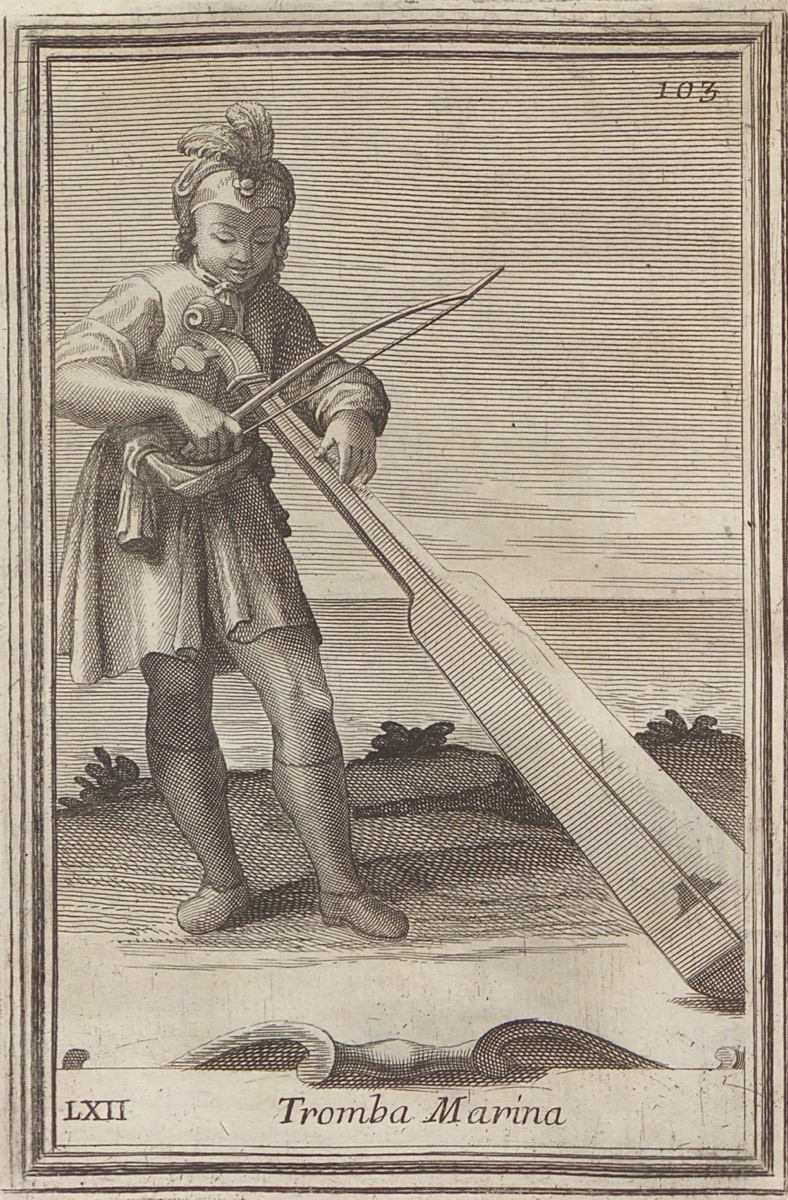
The tromba marina descends from the medieval monochord. Early instruments were plucked; by the fifteenth century the string was bowed [2]. It is a long, narrow, tapering box, often well over a metre and a half tall, standing on the floor or resting against the player's shoulder, with one principal string. In the seventeenth century makers added sympathetic strings inside the body [2].
The instrument travelled under many names: Trumscheit and Nonnengeige (nun's fiddle) in German, trompette marine in French, trumpet marine in English [1]. The second German name records one of its main homes: in convents it could take the place of the trumpet, an instrument traditionally played by men, and it was used to accompany sung plainsong [1, 3]. Theorists from Virdung to Praetorius and Mersenne illustrated it [4, 5, 6]. It reached the Baroque stage and literature: in Molière's Le Bourgeois gentilhomme (1670) the music master recommends it to Monsieur Jourdain, and Jean-Baptiste Prin, the best-known virtuoso of the instrument, wrote a treatise on it in the eighteenth century [7]. It fell out of use in the course of that century.
Its sound is the reason for its name. The bridge stands on two feet, but only one rests firmly on the soundboard. The other is left slightly free, and as the string vibrates it strikes the soundboard once in every cycle [2]. Those regular impacts turn the smooth tone of a bowed harmonic into a buzzing, brass-like sound. Acoustic measurements link this brassy quality to discontinuities in the phase of the radiated signal, the same family of effects found in loudly played brass instruments [8].
3. A string played in harmonics
A string of vibrating length L, tension T and mass per unit length μ has a fundamental frequency
and, in an ideal string, a series of partials at whole multiples of it, fn = n f0 [9]. Touching the string lightly at a distance L/n from one end does not shorten it; it forces a node at that point, silencing every mode that has no node there. What remains is partial n and its multiples. The player of a tromba marina touches near the upper end and bows above the touching thumb, in the short segment between the thumb and the nut.
Figure 3 writes out the series that a string tuned to C2 offers, partials 1 to 16, with the distance of each from equal temperament. Each partial is itself a complete vibration. When the string sounds partial n, it vibrates in n equal segments separated by nodes, and each segment behaves like a small string of length L/n with a harmonic series of its own: partials 2n, 3n, 4n and so on of the whole string. Touching at L/n therefore leaves a note with its own overtones, a series inside the series, which is why a harmonic sounds as a full tone and not as a thin sine.
On a fixed string the available notes are those of one harmonic series: an octave, a fifth, a fourth, then a major third and progressively smaller intervals as n rises, including the seventh and eleventh partials that lie outside equal temperament. This is the vocabulary the tromba marina shares with the natural trumpet, and the second reason, after its sound, for its name.
4. One string, many scales
That single series is the limit the trombone marino removes. Retune the string and the same hand positions give a different series. The trombone marino retunes with a motor at the nut while the string sounds, so a handful of fundamentals is enough to reach almost every pitch class, each in its own just intonation.
4.1 What one tuning offers
Not every partial lands on a note of equal temperament. The octaves of the fundamental are exact, the fifths and thirds lie close enough for a good string player, and a few partials, the 7th, 11th and 13th above all, fall between the notes of the piano; the 11th sits almost exactly a quarter tone away. Figure 4 shows where each of them lies.
Those in-between notes are part of what the trombone marino is for. Heard against their own fundamental they are consonant: they belong to the series and fuse with it. And because the fundamental is no longer fixed, the tuning itself becomes a choice made while playing. The motor can nudge the fundamental so that one chosen partial lands on its equal-tempered note, or leave it alone and let the whole series sound pure.
Figure 4 follows the hand through partials 1 to 16 on five fundamentals; each new fundamental adds the notes the others lack. Press Sound to hear each partial at its real pitch. The lowest partials need headphones or speakers that reach below 60 Hz.
4.2 Twelve fundamentals
Figure 5 extends Figure 4 to every semitone from C1 to B1. Each row is folded into a single octave, so the columns are pitch classes and a dot between two columns lies between two equal-tempered notes. The motor reaches up to F2, but those fundamentals repeat the first rows an octave higher. Every row has the same shape, moved one column to the right: the string does not change, only where it sits against equal temperament. The five pure notes travel with the fundamental, and so do the three that miss equal temperament.
4.3 Four tunings, twelve notes
Because every tuning offers the same five pure notes, the number of tunings a player needs has an exact answer. Checking every combination of fundamentals, four are enough to reach all twelve pitch classes within 15 cents, and one solution is four neighbouring semitones: C1, C♯1, D1 and E♭1. The motor then moves by no more than a minor third. If the 7th partial, 31 cents flat, is accepted as a note in its own right, three tunings are enough. A monochord from the Middle Ages becomes a chromatic instrument with a motor that hardly travels. Figure 6 shows how close together these four tunings are, with every note at its real octave: tap a key and the motor goes to the nearest tuning that has it.
4.4 One pitch, three tunings
The same note can often be played in more than one way. Because the motor is continuous, the fundamental can be set exactly where a chosen partial lands on a note. High in the series the partials lie close together, so a small move of the motor and a small step of the hand give the same pitch from a neighbouring partial. C5, for example, is the 16th partial of C1, the 15th of a slightly raised C♯1 and the 14th of a slightly raised D1, all within a minor third of motor travel (Table 1). The pitch stays the same; what changes is where the hand touches, the colour of the note and the harmony it belongs to. A note can be held while the series under it changes.
| Partial n | Fundamental | Motor from C1 | Role of the C5 | Hand from the nut |
|---|---|---|---|---|
| 16 | C1 | 0 c | fourth octave | 8.7 cm |
| 15 | C♯1 +12 c | 112 c | major seventh | 9.3 cm |
| 14 | D1 +31 c | 231 c | harmonic seventh | 9.9 cm |
4.5 Fundamental and partial
The two gestures of the instrument are therefore two musical decisions. The hand chooses the partial, which is the role of the note in its harmony: root, fifth, third, seventh. The motor chooses the fundamental, which is the harmony the note belongs to. A melody can be played with the motor still, as on the historical instrument, or the same melody can be harmonised from below, note by note, by choosing for each note the series it is heard in. Notes shared by two series are meeting points: a phrase can end in one tuning and continue in the next from the same pitch, as a common tone joins two keys in a modulation.
Writing for the trombone marino therefore needs a tablature of two lines, fundamental and partial. A tool that proposes both from a melody, choosing for each note either the purest intonation or the fewest motor moves, is the natural next step; its output would be the same kind of tuning line as the one in Figure 10.
5. The trombone marino
5.1 Principle
Equation (1) shows that the fundamental can be changed without touching the vibrating length, by changing the tension. In the trombone marino a motor does this continuously while the string is bowed. The sounding pitch becomes
with n chosen by the left hand and f0 by the motor. Holding the hand still and moving the motor slides the whole harmonic series: a melody played by the tuning. Holding the motor still and moving the hand gives back the historical instrument. Moving both reaches intervals that no single fixed string contains.
5.2 Construction
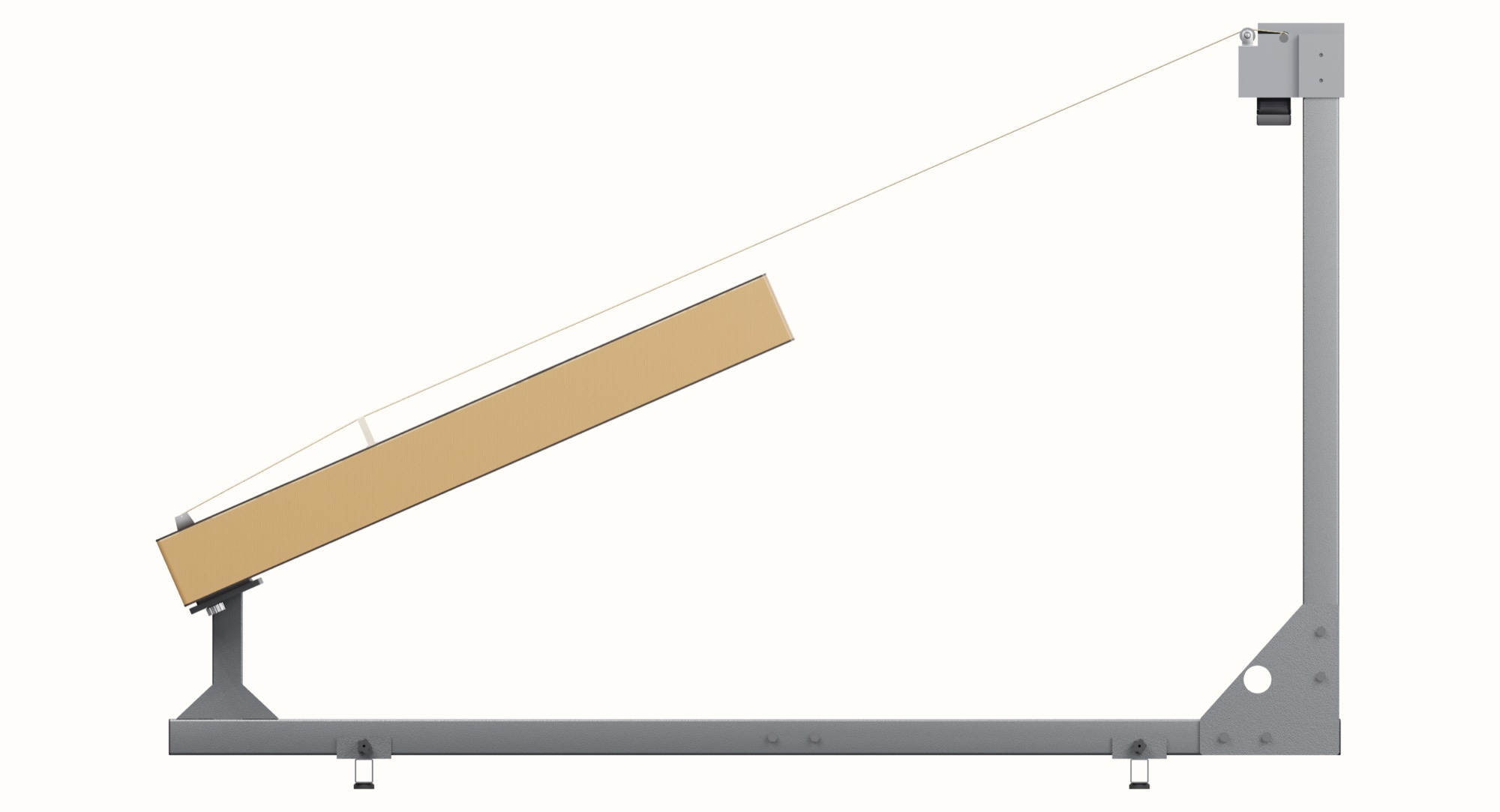
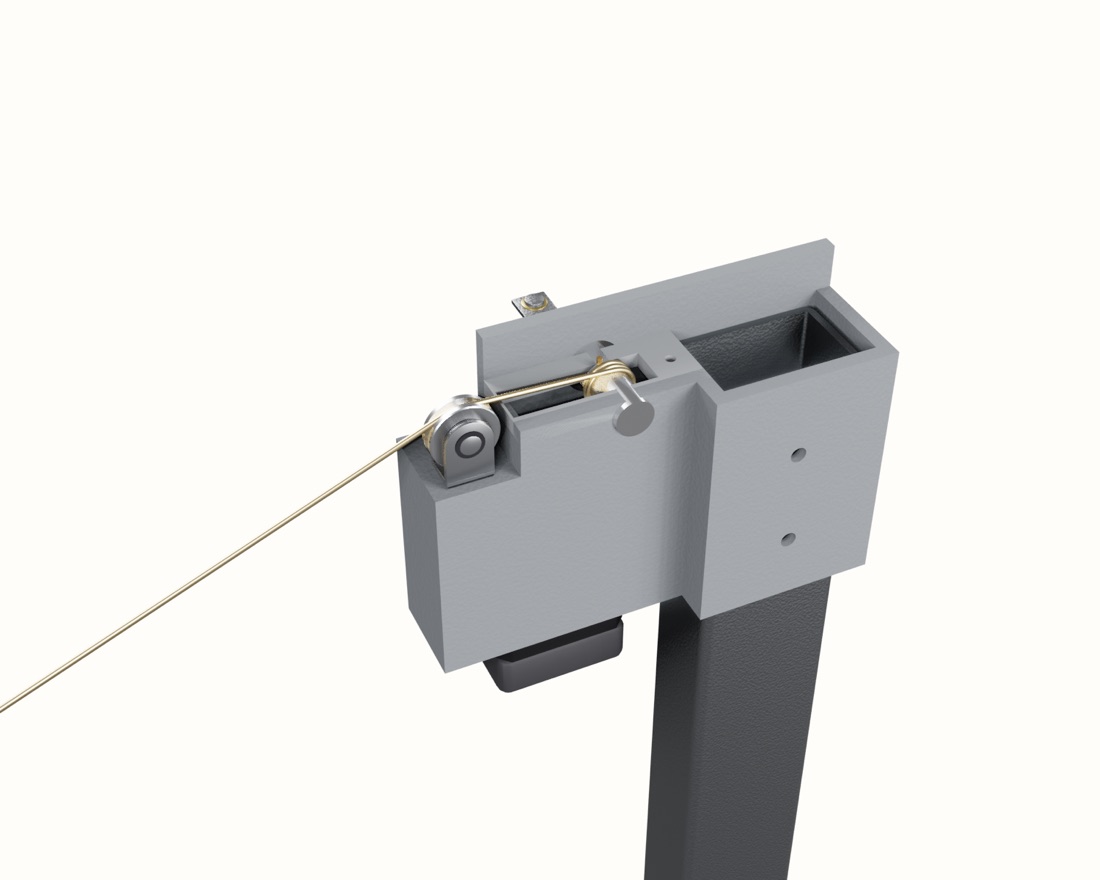
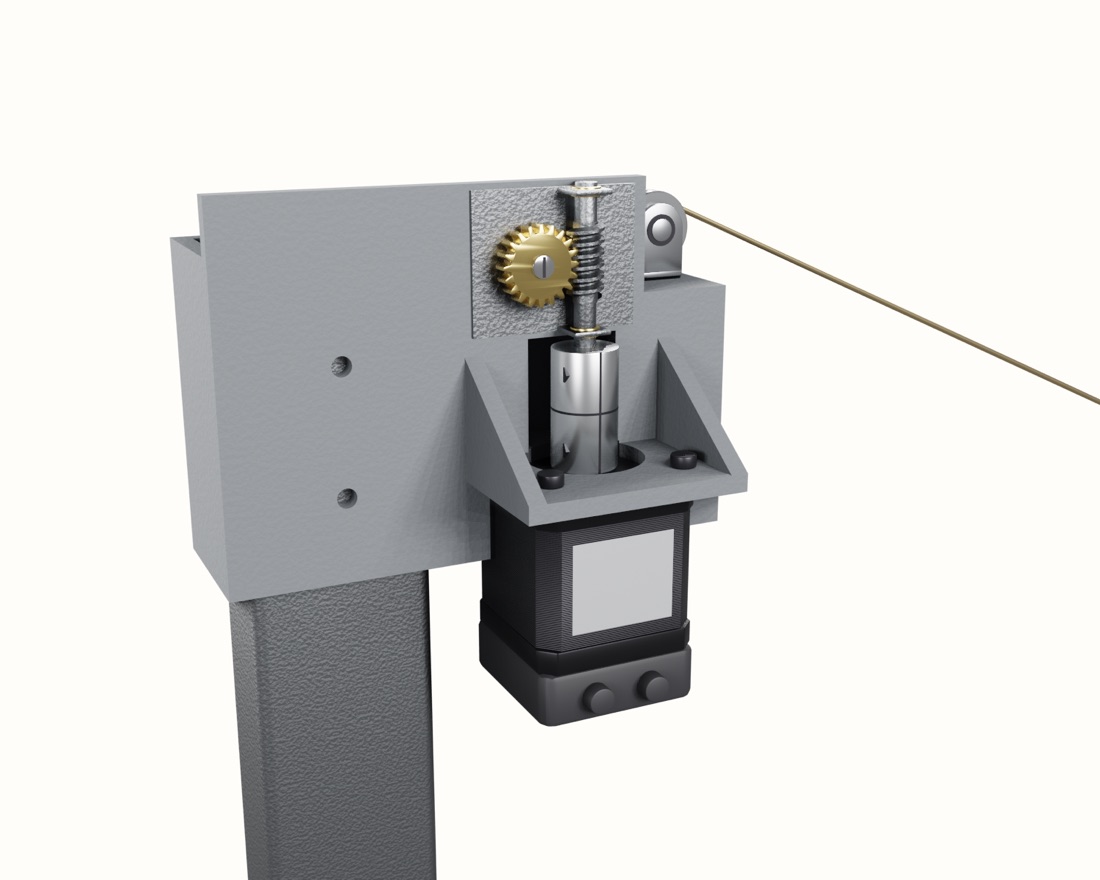
The string is a double bass G string over a vibrating length of about 1.4 m. It runs along a wooden resonating body carried by a welded steel frame. At the upper end, a 3D-printed head box couples a NEMA 23 stepper motor to an ordinary double bass machine head. The machine head's worm gear cannot be driven backwards by the string, so tension holds when the motor is unpowered. Magnetic encoders on the motor and on the peg report their positions. Pitch is picked up by a piezo under the bridge.
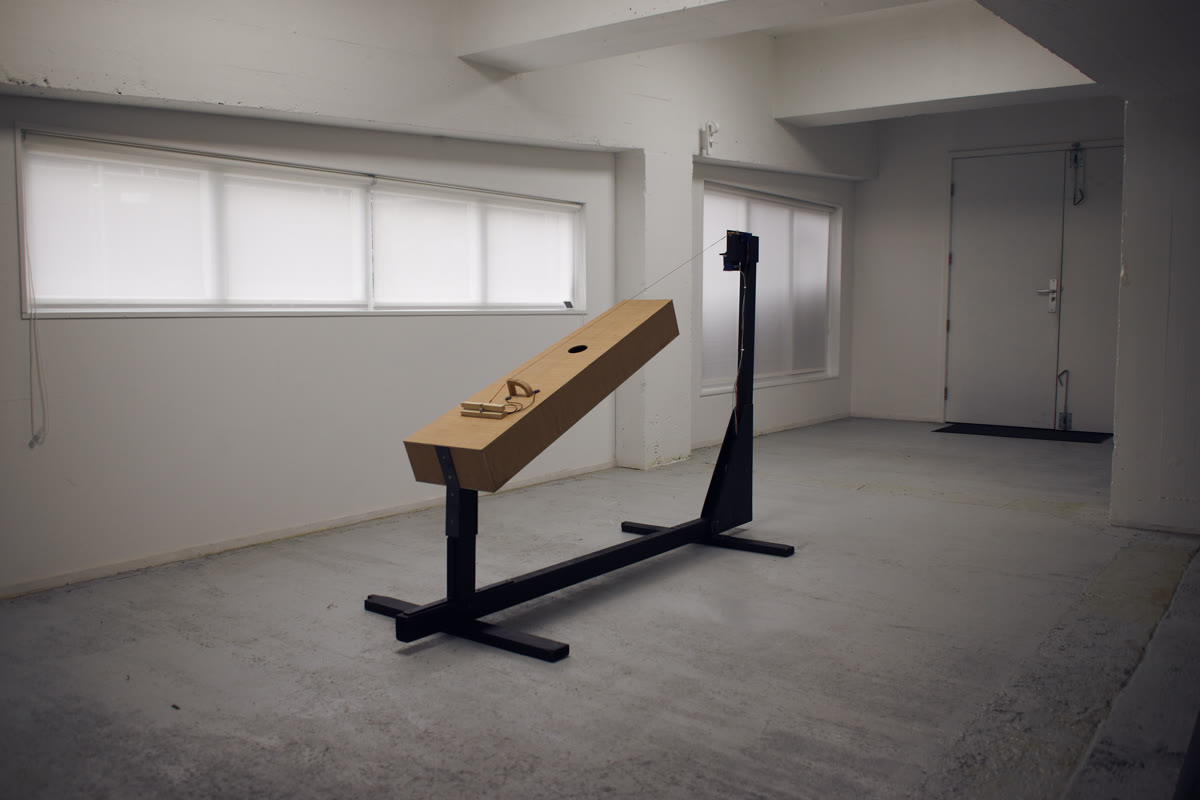
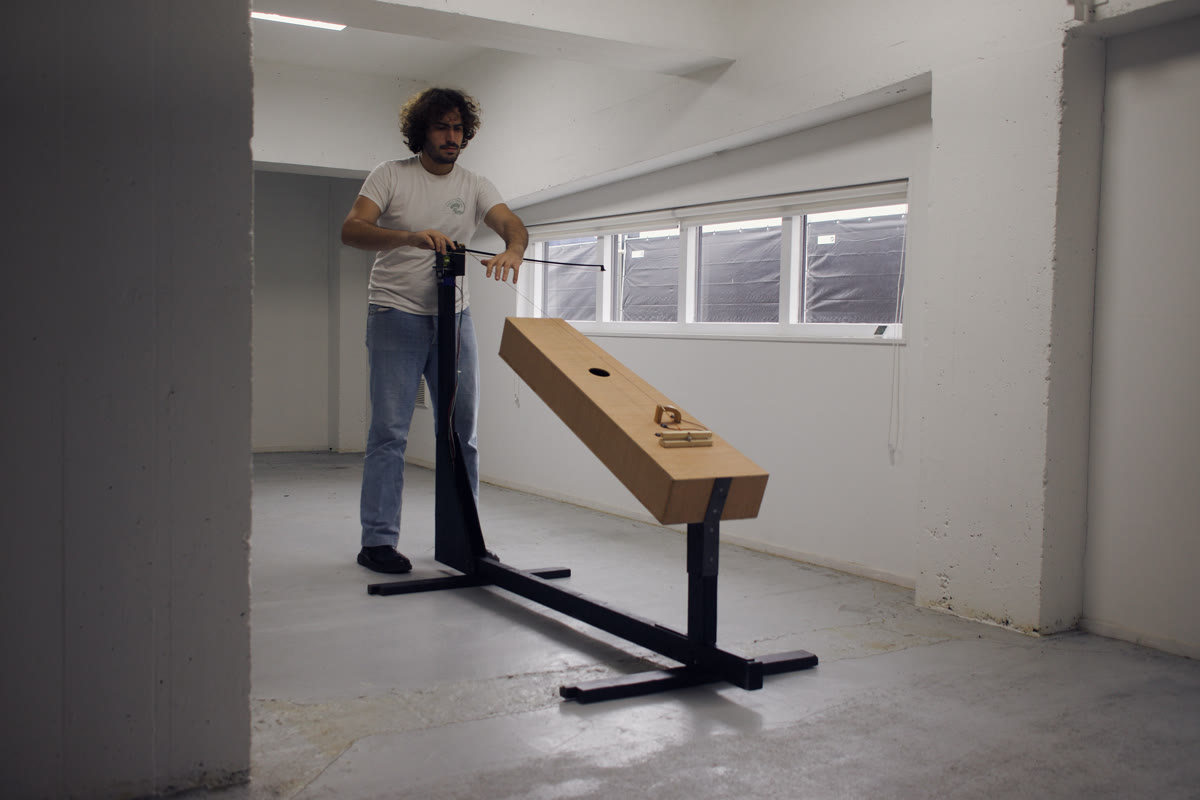
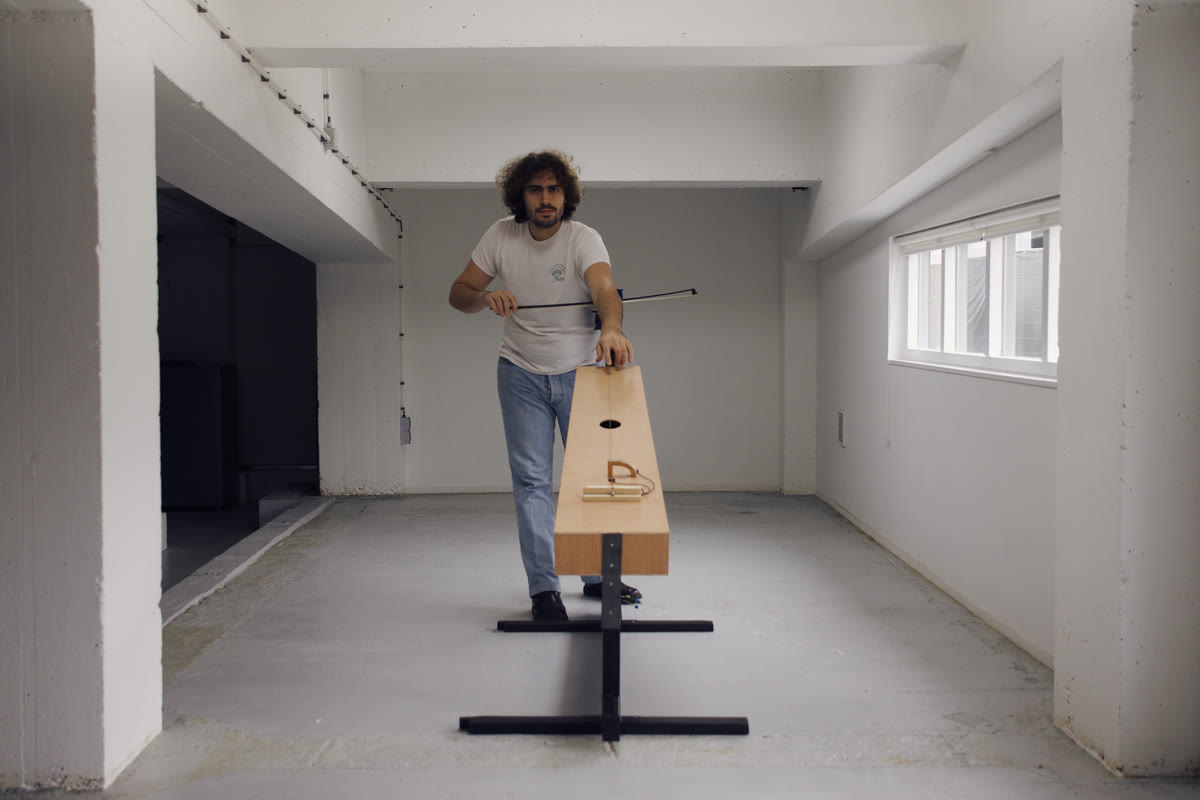
5.3 Control
A microcontroller drives the motor and answers position commands from a computer. The musical intelligence runs in two devices inside Ableton Live. The first listens to the piezo and tracks pitch. The second keeps a map of peg position against fundamental, learned by sweeping the string slowly and refined every time a note lands. Because the player sounds harmonics, the tracker must not confuse the sounding partial with the fundamental: on arrival at a target, the measured pitch is folded back by the partial number before the tuning is trimmed. The player steers the fundamental with a pressure-sensitive foot controller, or writes it in advance as an automation lane, a line of tuning against time, which can also be recorded from the feet and looped. Figure 10 shows the first such recorded line.
The microcontroller of the prototype is far more powerful than this task needs. Its spare capacity points to a self-contained version: the Max patches could be exported as code that runs on the board, for instance with Cycling '74's RNBO, and part of the sound processing could run there too, so that the instrument plays without a laptop. That version is still to be developed.
5.4 Mapping the string
Before the motor can play notes, the system has to know where they are. Figure 11 is the first map of the prototype, measured on 23 September 2026 with a new double bass G string at 139 cm vibrating length. The motor turned the peg in steps of about two degrees and stopped after each one, the pitch of the bowed open string was read from the piezo, and the same was done on the way back down.
On the way up the string rose from B0 (31.5 Hz) to C♯2 (70.9 Hz), more than an octave, in a little under one turn of the peg. The square of the frequency rises almost in a straight line with the rotation, within 30 cents over the whole climb, as equation (1) predicts when the tension grows in proportion to the stretch. A semitone therefore costs more rotation the higher the string is tuned: about 10 degrees of peg at the bottom of the range and close to 40 near the top. On the way down the string sounded flat of the way up at the same peg angle, by a few cents near the top and by about two semitones at the bottom. Motor and peg agreed to within a few steps, so the mechanism had not slipped: the new string was stretching under a tension it had never reached before. A map is valid only once the string has settled, and the system relearns it whenever the heard and the expected pitch disagree.
The top of the map was set by the motor, not by the string: at C♯2 it stalled, at about 90 percent of the string's design tension. It can still take the string up to F2, but only slowly. At low tension the motor moves quickly, so the low register is where the fundamental can be played fastest, almost as an ornament, and the top is where it can only be moved slowly. A stronger motor, or less friction in the worm and the peg, would move that limit up.
The map was measured on the wooden prototype, whose frame bent and kept settling as the tension rose, so part of the gap between the way up and the way down belongs to the frame and not to the string. The welded steel frame was built to be stiff enough not to creep. Its map should be steeper and repeatable, and is still to be measured.
The machine head is itself a reduction gear: its worm turns about twenty times for each turn of the peg. This gives a small motor the torque to hold a double bass string and the resolution to place it within a cent, and it is why the string cannot turn the worm backwards. A planetary gearbox between motor and worm could add torque, at the cost of speed.
A string that is tightened and released all day wears quickly. To make it last, the instrument keeps the string below its design tension and runs it over a roller nut, so that it does not rub at every move of the motor.
6. Play it
Figure 12 is a simplified trombone marino to play in the browser. The bow never stops. The keys 1 to 9 choose the partial, as the left hand does by touching the string; hold two of them together to touch two nodes at the same time (section 7). The up and down arrow keys drive the motor between C1 and F2, the range of the prototype. Each number button shows the note it would give at the present tuning, so the scale under the hand can be watched as it moves. On a phone or tablet, use the buttons.
The sound is a synthetic stand-in, a bowed tone at the right pitch, not a recording of the instrument. The motor here is quieter and freer than the real one, whose speed is limited by the load of the string.
7. Two nodes at the same time
The tromba marina gives one hand to the string and one to the bow. If the string is bowed by something else, it can be touched at two nodes at the same time, and the harmonics combine in a simple way. A light touch silences every mode without a node at that point; two touches leave only the modes with a node under both. Touching at L/a and L/b therefore sounds the least common multiple of a and b (Figure 13): L/2 and L/3 give the sixth partial, L/3 and L/4 the twelfth. High partials, which one hand would have to find within a few centimetres of the nut, come from two wide positions that are easy to hit. Try it in Figure 12 by holding two number keys together. A rosined wheel, as on the hurdy gurdy, could do the bowing and free both hands.
8. Electronics and Ableton Live
The trombone marino is meant to be played with sound processing. Figure 14 shows one possible way to set it up: the instrument holds only what has to be close to the string, and everything that knows about notes runs in Ableton Live.
The microcontroller also makes a fully local version possible, with the motor control and the sound processing on the instrument itself, and MIDI in and out to a computer or any other device. MIDI is the delicate part. A string is not as free as an oscillator: it cannot jump, it moves slowly at the top of its range, and only some of the notes a MIDI stream can ask for are physically reachable at a given moment. A MIDI implementation has to know what the string can do; it is possible, but it needs care. For now the instrument keeps the pipeline described here, from Ableton Live and Max for Live to the microcontroller, and more can be built on it later.
8.1 The motor side
The microcontroller sends step and direction pulses through a 74HCT245 level shifter, which lifts them from 3.3 to 5 volts, to a DM542 stepper driver on a 36 volt supply. The driver runs the NEMA 23 motor at 800 steps per turn, and the motor turns the worm of the machine head 20.4 times for every turn of the peg, so one step moves the peg by less than a fiftieth of a degree. Two AS5600 magnetic encoders, one on the motor shaft and one on the peg, read their angles; both chips answer at the same address, so each has its own I²C bus. Together they give an absolute position that survives a reboot: the peg encoder counts the turns, the motor encoder the steps within them.
The driver's inputs are optically isolated, and the 36 volt return is kept off the logic ground, so that the motor's switching noise stays out of the audio.
The microcontroller is a motor server and knows nothing about notes. Over USB it receives one line of text per command: go to a position, glide to a position, move at a speed, stop. An interrupt running 100 000 times a second turns these into steps with a limited acceleration. Every target is approached from below, so the slack in the worm is always taken up in the same direction. While the motor moves, the microcontroller reports its position 50 times a second; on arrival it switches the motor current off, rereads the encoders and reports how many steps it had to correct. If the motor shaft falls behind the steps sent, it stops dead and reports a stall.
8.2 Two Max for Live devices
TrombaEar sits on the piezo track. It keeps the last 170 milliseconds of the signal and estimates its pitch 20 times a second with the YIN algorithm, first on a copy at a quarter of the sample rate and then refined at full rate around the first guess, in about 5 milliseconds. Frequency, clarity and level go to TrombaBrain as network messages on the same computer.
TrombaBrain is a MIDI effect on its own track (Figure 15). It holds the map of peg position against fundamental for each string, plans every move, talks to the microcontroller and reads the foot controller. Its screen shows the target note and the error in cents, the pitch heard, the state of the device and the position of the peg. LEARN builds a map by sweeping the string up at a quarter of a semitone per second while it is bowed, and stops by itself where the pitch stops rising. REFINE goes back over the map note by note. LOCATE finds the peg from the pitch heard. TRIM switches the correction on arrival on and off, and the three numbers set its tolerance in cents, the string in use and the highest note allowed.
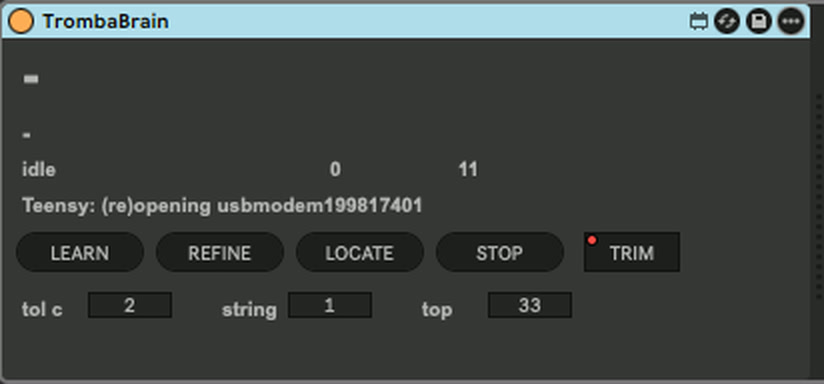
On every arrival TrombaBrain listens and corrects. The player may be sounding any partial, so the heard pitch is first divided back to the fundamental; then the motor trims the string until the note is within two cents, and each correction also improves the map. Both patches are small (Figure 16): all the logic sits in one JavaScript box, tested outside Max in a simulator before it reaches the instrument.
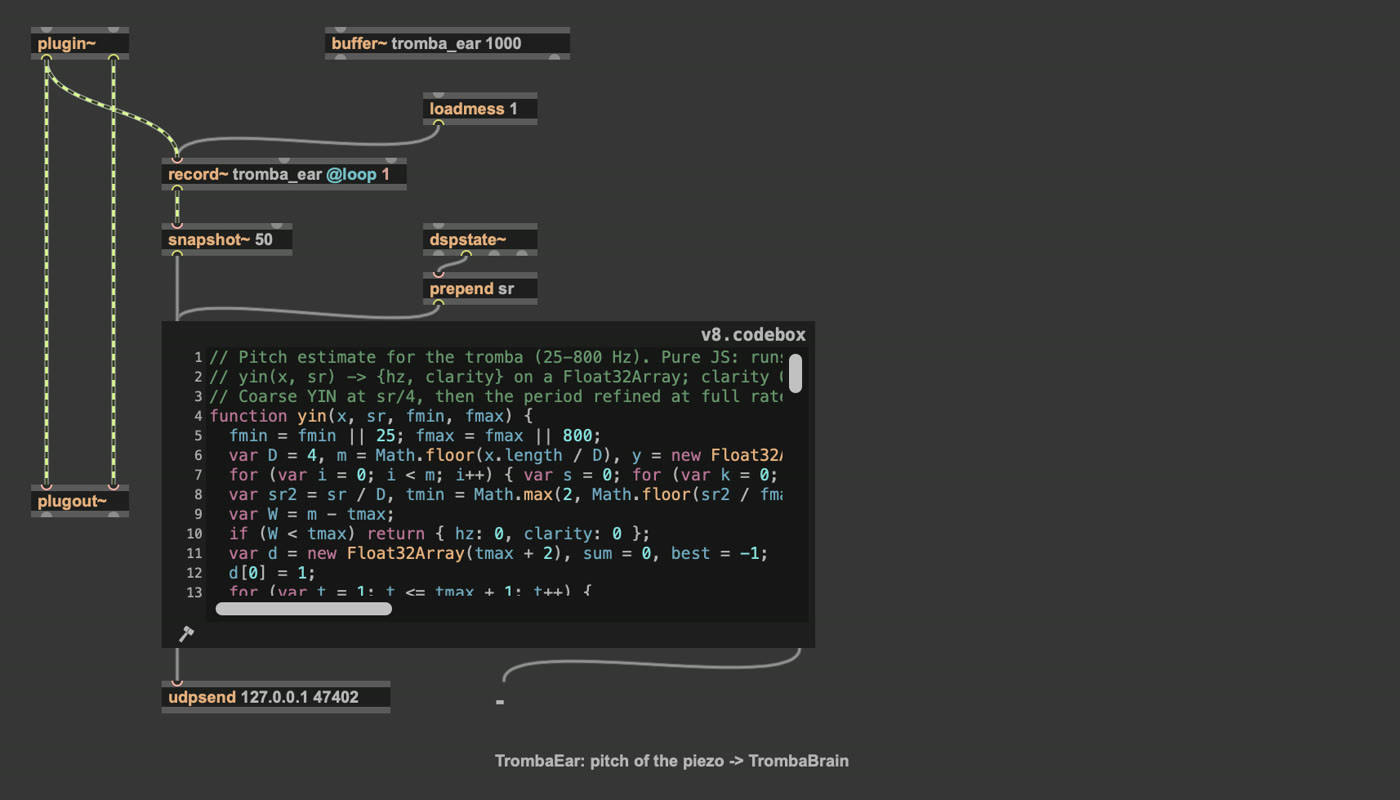
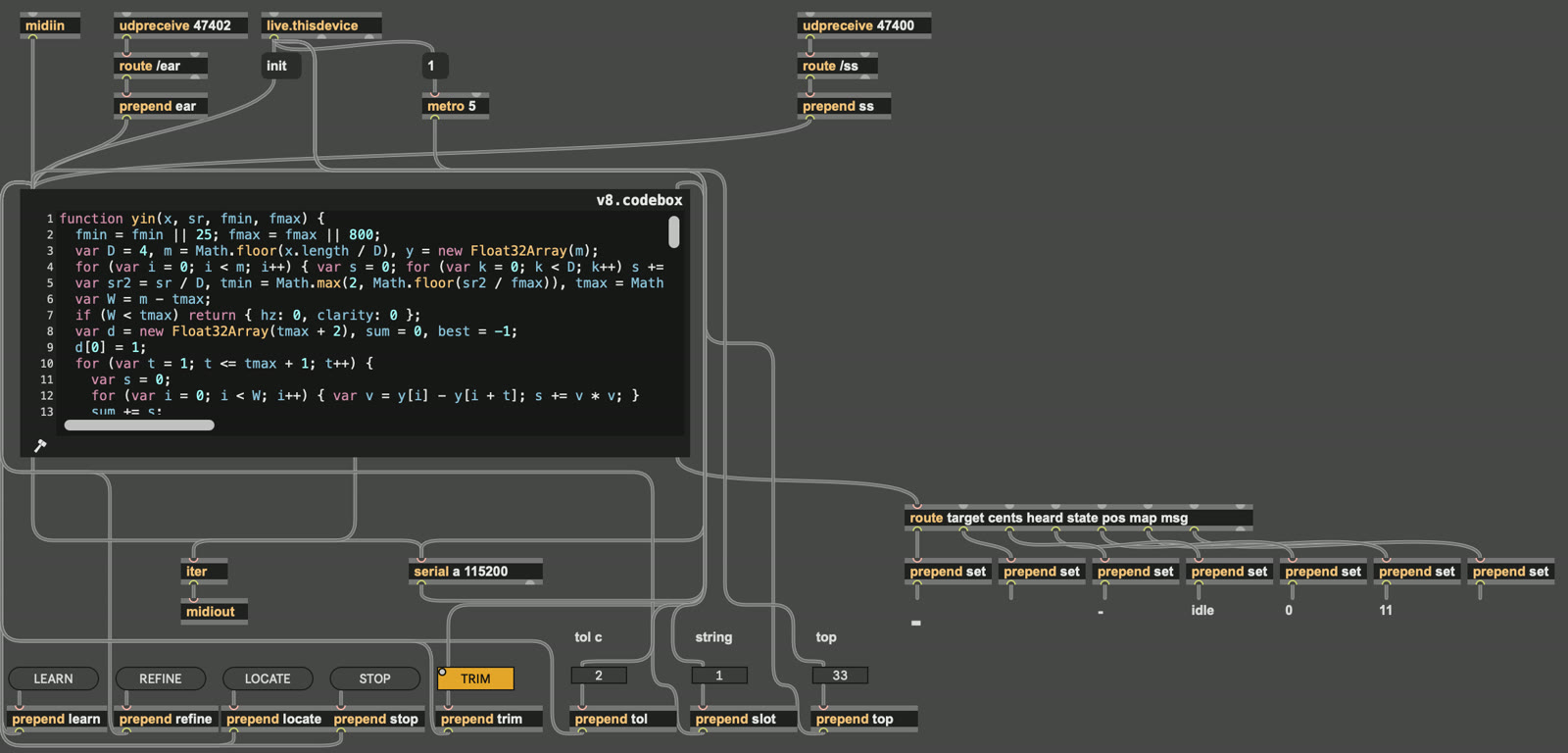
plugin~ to plugout~); a copy loops in a one-second buffer (record~), snapshot~ 50 reads where the recording head is every 50 milliseconds, the JavaScript box runs YIN on the last 170 milliseconds and udpsend passes the pitch on. Bottom, TrombaBrain: midiin, the ear (udpreceive 47402) and the pads (udpreceive 47400) at the top; the JavaScript box that holds the map, the moves and the trim; serial a 115200 to the microcontroller; the screen on the right; the buttons and numbers of the device along the bottom.The feet play through a SoftStep 2, a foot controller with pressure-sensitive pads. Some slide the fundamental, some move it by a semitone or a tone, and two record and replay a loop of the motor's movement, which Live records together with its sound.
8.3 Sound
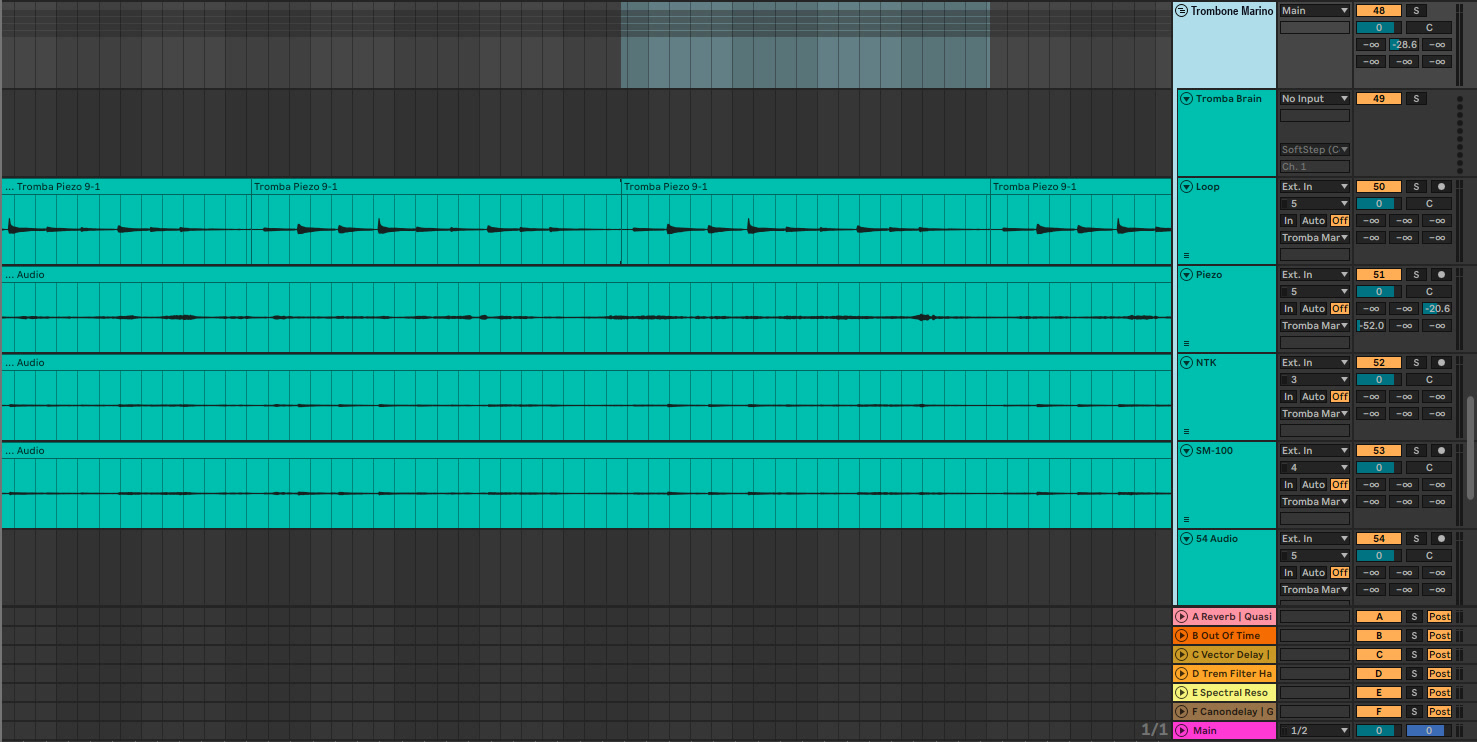
The piezo under the bridge gives a dry, close signal, and it reaches Live untouched, so that TrombaEar always hears the string itself; the processing comes after the ear. One possible chain sends the signal out to a Chase Bliss MOOD, a pedal with two halves: a wet channel of reverb, delay or slip, and a micro-looper that catches short fragments of the string and plays them back, stretched, slowed or reversed, against the live sound. Back in Live the instrument has its own group (Figure 17), with a Glue Compressor, Roar for saturation and an EQ Eight, and sends to the return tracks of the session. The choice of effects changes from take to take; the recordings below each use the pedal together with Live's processing and mixing.
8.4 Recordings
Three takes on the prototype, each with the MOOD pedal and processing in Live.
Solo performance, with motor loop, pizzicato and bowed. 3:05
Pizzicato, with processing. 0:26
With trumpet. 1:15
9. A new colour in the string family
Bowed strings already offer a wide palette: stopped notes, natural and artificial harmonics, sul ponticello, col legno. In all of them the harmonic series is anchored to a note the player has fixed with the left hand. The trombone marino offers something none of them has: a harmonic series in motion. A held seventh partial can glide by a fifth while the left hand stays still. A chord of overtones can bend as one body. Intervals of just intonation appear naturally, and the space between them is continuous rather than divided into semitones.
The instrument also keeps a property of its ancestor that many modern strings lack: it is loud and penetrating in the register of a voice, while its fundamental sits in the range of the double bass. That makes it a partner for brass and voices as much as for strings, and a source of slowly changing drones for electronic music, since its tuning is already a stream of MIDI data.
The bridge was also the most delicate part of the historical instrument. Its free foot rests about 20 micrometres above the soundboard, a gap set with an adjuster the French called the guidon; players kept two or more good settings and moved between them, even within a piece [8]. One of the instruments discussed in that study is a tromba marina in Bologna, probably by Rombouts (Figure 18) [8]. Seeing it at the Museo della Musica in Bologna was one of the starting points of the trombone marino.
Here the trombone marino takes a different turn. The sound of a bridge that strikes the soundboard at a single point is fascinating, but it can be too metallic, and its range of colour is narrow. A version of the historical bridge was built for the prototype, after the simpler design of a tromba marina kept in Copenhagen [11]. It did its job: it rattled steadily on the higher partials, less regularly on the open string and in the low register. But it was not enough. For the performances in the video and the recordings of section 8, the string was set in the middle of the bridge, which removes the rattle altogether.
The way forward comes from the Tromba Moderna, a digitally augmented tromba marina built in Copenhagen. At the end of their paper its builders proposed a bridge whose rattle is switched on and off by an electromagnet that holds or releases the vibrating foot [12]. The trombone marino will implement this idea, with a bridge on three legs (Figure 19). The two main feet stay loaded, so the instrument can always play clean. A thin third leg reaches sideways and ends in a steel screw over a bone striker. Like the guidon, the screw sets the gap; it also does the striking, and it is the armature of a small electromagnet held from the body side. More current lifts the tip and the rattle fades; no current lets it strike. The rattle becomes something the player can blend in and out while playing, and a piezo disc under the striker records it on a channel of its own.
10. Transport
An instrument is only as useful as the places it can reach, and the trombone marino is meant to travel with its player. The touring version is designed to come apart completely: the frame separates into the arm and the two halves of the base, and the body, the bridge, the electronics and the foot controller all come off, so that the whole instrument packs into a single case (Figure 20). Taken apart like this, it can fly as an instrument in the hold or on a seat of its own.
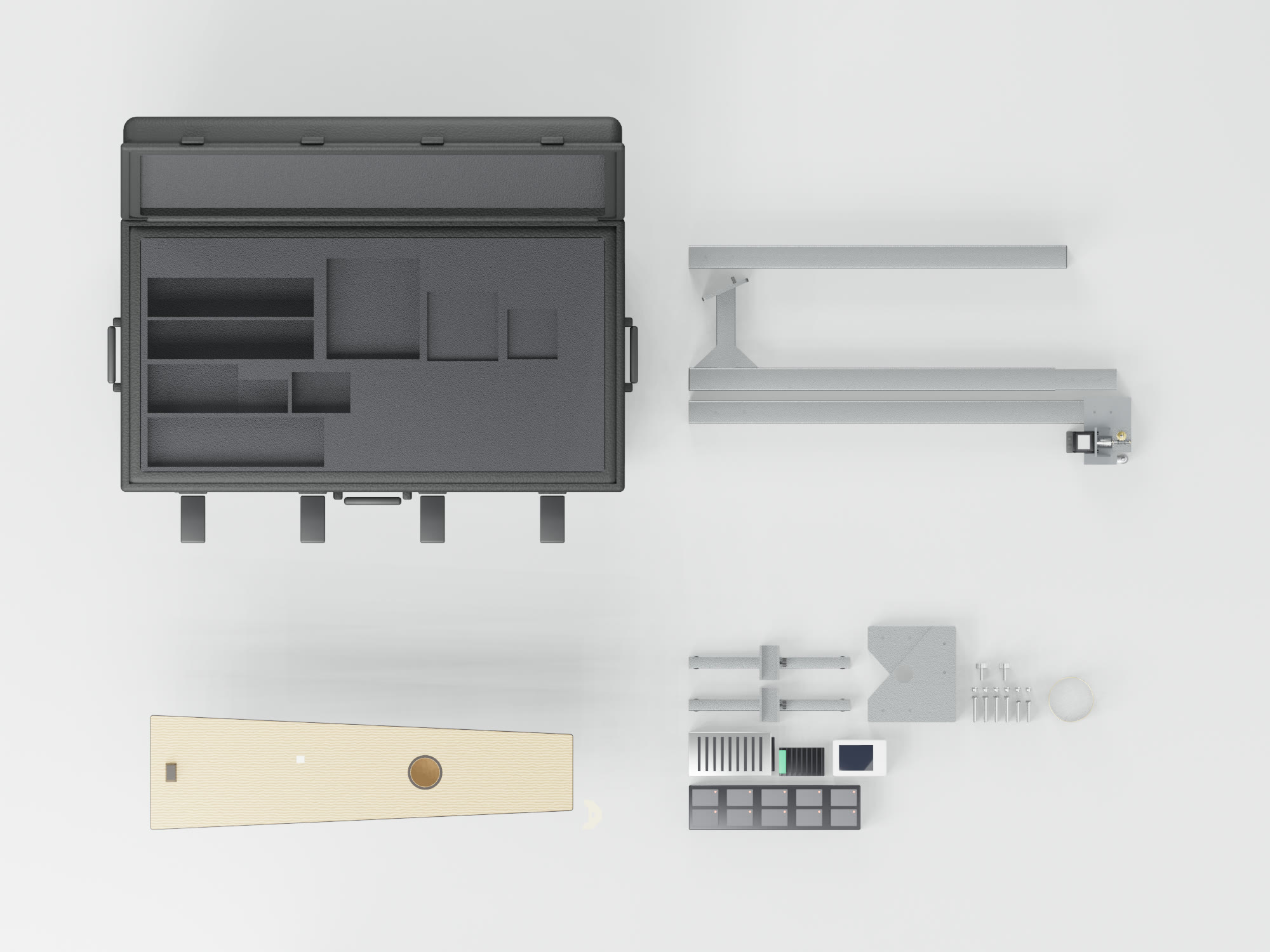
What remains to be solved is the weight. The prototype frame is welded steel, chosen for its stiffness, and steel is heavy. The next step is a study of materials to find a frame that is just as stiff and does not creep under the tension of the string, but is much lighter. Carbon fibre is the most promising candidate, with aluminium and hybrid frames as alternatives; the shape of the instrument stays as it is.
11. Conclusion
The tromba marina was limited by its fixed harmonic series, not by its sound. By motorizing the one part of the instrument that was meant to stay still, the trombone marino keeps the ancient technique intact and adds a second, continuous dimension to it. Every note is the meeting point of two gestures, one from the hand and one from the feet.
References
- “Tromba marina.” Wikipedia. en.wikipedia.org/wiki/Tromba_marina
- “Trumpet marine.” Encyclopædia Britannica. britannica.com/art/trumpet-marine
- Victoria and Albert Museum, trumpet marine, object O58940. collections.vam.ac.uk/item/O58940
- Virdung, S. Musica getutscht. Basel, 1511.
- Praetorius, M. Syntagma musicum II: De Organographia. Wolfenbüttel, 1619.
- Mersenne, M. Harmonie universelle. Paris, 1636.
- Adkins, C. and Dickinson, A. A Trumpet by Any Other Name: A History of the Trumpet Marine. Buren: Frits Knuf, 1991.
- Padilla, A. and Gibiat, V. “The ‘trumpet marine’, an instrument between a trumpet and a violin.” Forum Acusticum, Budapest, 2005. PDF
- Fletcher, N. H. and Rossing, T. D. The Physics of Musical Instruments, 2nd ed. New York: Springer, 1998.
- Bonanni, F. Gabinetto armonico pieno d’istromenti sonori. Rome: Giorgio Placho, 1722. Plate LXII. archive.org/details/A041464
- Willemsen, S., Serafin, S., Bilbao, S. and Ducceschi, M. “Real-time implementation of a physical model of the tromba marina.” Proceedings of the 17th Sound and Music Computing Conference, Turin, 2020, pp. 161-168. doi.org/10.5281/zenodo.3898741
- Baldwin, A., Hammer, T., Peciulis, E., Williams, P., Overholt, D. and Serafin, S. “Tromba Moderna: a digitally augmented medieval instrument.” Proceedings of the International Conference on New Interfaces for Musical Expression, Brisbane, 2016, pp. 14-19. nime.org/proc/nime2016_baldwin
The trombone marino is designed and built by Lorenzo Servali in Amsterdam. Recordings of the instrument are on the recordings page. For collaborations, commissions or a demonstration, write to info@lorenzoservali.com.